New paint job.

One of 6 murals which have been painted across Hampshire, all depicting sea creatures.

As well as this lobster on the harbour master’s office at Warsash on the River Hamble other sea creatures are at Hythe Pier, & Ocean Village in Southampton and others on the Isle of Wight.

Candy Stripe spider.

Common Candy-striped Spider Enoplognatha ovata.

This spider can reach a length of 6 mm (excluding legs), and their legs are translucent. This spider’s globular abdomen is extremely variable in colour and pattern their background colour is white/cream or green and can be marked with a row of dark spots, a broad red stripe or with two red stripes in a v-shape. Despite its small size, this spider can prey on insects many times its size. 

Egg Sack.

This spider was within a field of thistles.

Sundew safari.

There are many carnivorous plants native to the UK. These are Sundews, Butterworts and Bladderworts. Sundews are not a common plant in southern England. However, in the New Forest, they are widespread in many of the boggy areas. In the New Forest, there are 3 types of Sundew. The Round-leaved Sundew seems to be the most abundant and as its name has a round end to the leaves, The Oblong-leaved Sundew is also fairly easy to find. It has longer, narrower leaves. The Great Sundew is twice as large as the oblong-leaved plant I have not found one yet.

You need to get down low to get a good view of these interesting little plants.

Round-leaved Sundew.

(to get a scale the pad on this plant is about the size of my little fingernail).

Sundews eat insects! They produce a sticky ‘glue’ all over the leaves; insects become trapped in the glue, the plant curls the leaf edges over and releases digestive enzymes that consume the insects, passing nutrients into the plant.

Oblong-leaved Sundew.

The picture below shows the Sundew with a flower bud.

And down came a spider.

A spider’s nest on some bracken. The nursery web spider builds a nest and is very parental overseeing the eggs and carefully supporting the baby spiders when they hatch. In this nest, they have already hatched turning the leaf to look brought out the mother spider!
What gall!

An interesting growth on a Dog Rose known as a rose bedeguar gall, Robin’s pincushion, mossy rose gall or moss gall. A gall wasp known as Diplopepis rosae causes these galls (Plant galls are abnormal outgrowths of plant tissues, similar to benign tumours) they mainly develop directly after the female insect lays the eggs. 

Cattle & Ponies.

Another New Forest walk yesterday. Much cooler this morning- The recent heatwave has left its mark. Many of the streams have dried up along with some of the pools where we study Dragonflies. Much of the grass is baked brown the whole forest waits for some of the forecast rain and thunderstorms.

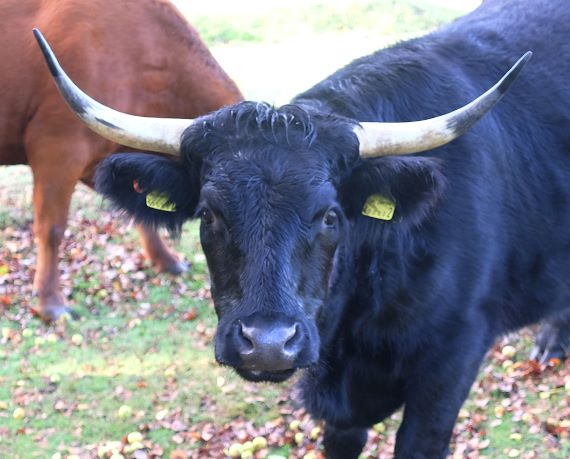
The cattle and ponies are staying close to or regularly drinking water places such as Cadnams Pool. Due to the lack of fresh grass, they are eating leaves from the trees.

BBQs and open fires are now banned in the New Forest due to the fire risk. Although there are a lot of green areas within the forest underfoot the grass and gorse is tinder dry.

Ponies cooling off. Note the cotton grass in a green area of none brown grass at the end of the film which warns of a boggy area.

Remembered.

The Royal Canadian Army Service Corps.

The Canadian Memorial is a simple wooden roadside cross with two flag poles. It is situated overlooking the sloping ground, near Bolderwood on a forest road leading to Emery Down.
The memorial remembers World War Two Canadian forces present in the New Forest before the D-Day invasion of June 6th, 1944 ‘

At this site, during the build-up to D-Day, Canadians were stationed in the area. It is also close to one of Forest’s wartime airfields at Stoney Cross.

A plaque with an inscription reads: ‘On this site, a cross was erected to the glory of God on 14th April 1944, by men of the 3rd Canadian Division RCASC’ ( the Royal Canadian Army Service Corps.)

On D-Day, RCASC soldiers of the 3rd Canadian Division and 2nd Armoured Brigade landed on Juno Beach.

Is this the end of the world as we know it?

We have survived a heatwave last 3 days the weather has caused a total meltdown here in the UK. Being obsessed with the weather we Brits have been totally preoccupied with what the temperature is and our infrastructure failings however we have short memories and in a few weeks, we will have forgotten what the effects of extreme heat are and climate changes are and we will return to our selfish ways.

A major fire swept through Hook nature reserve on Southampton Water near Washash.

We have been spending a lot of time during the heatwave by the sea at our usual spot on Meon Shore. The sea breeze helped cool the air and allow some comfort.

Probably the coolest place in the UK was on the water sailing in a yacht out in the Solent. These were sailing off Cowes on the Isle of Wight. Pictures were taken through a heavy heat haze from Meon Beach

Some people found other ways of keeping cool! Please note a hat is essential.

Some bird watching from the water’s edge. Despite the number of people on the beach birds were plentiful.

Oystercatchers.

Turnstones.

Herring Gull. (With attitude.)

Common Terns.

A young tern thinks he has caught a big fish!

Work goes on for others whatever the weather.

Experimental Hovercraft.

Shipping leaving port.

Search and Rescue Helicopter on patrol.

Thunderstorms and cooler weather are now forecast.